
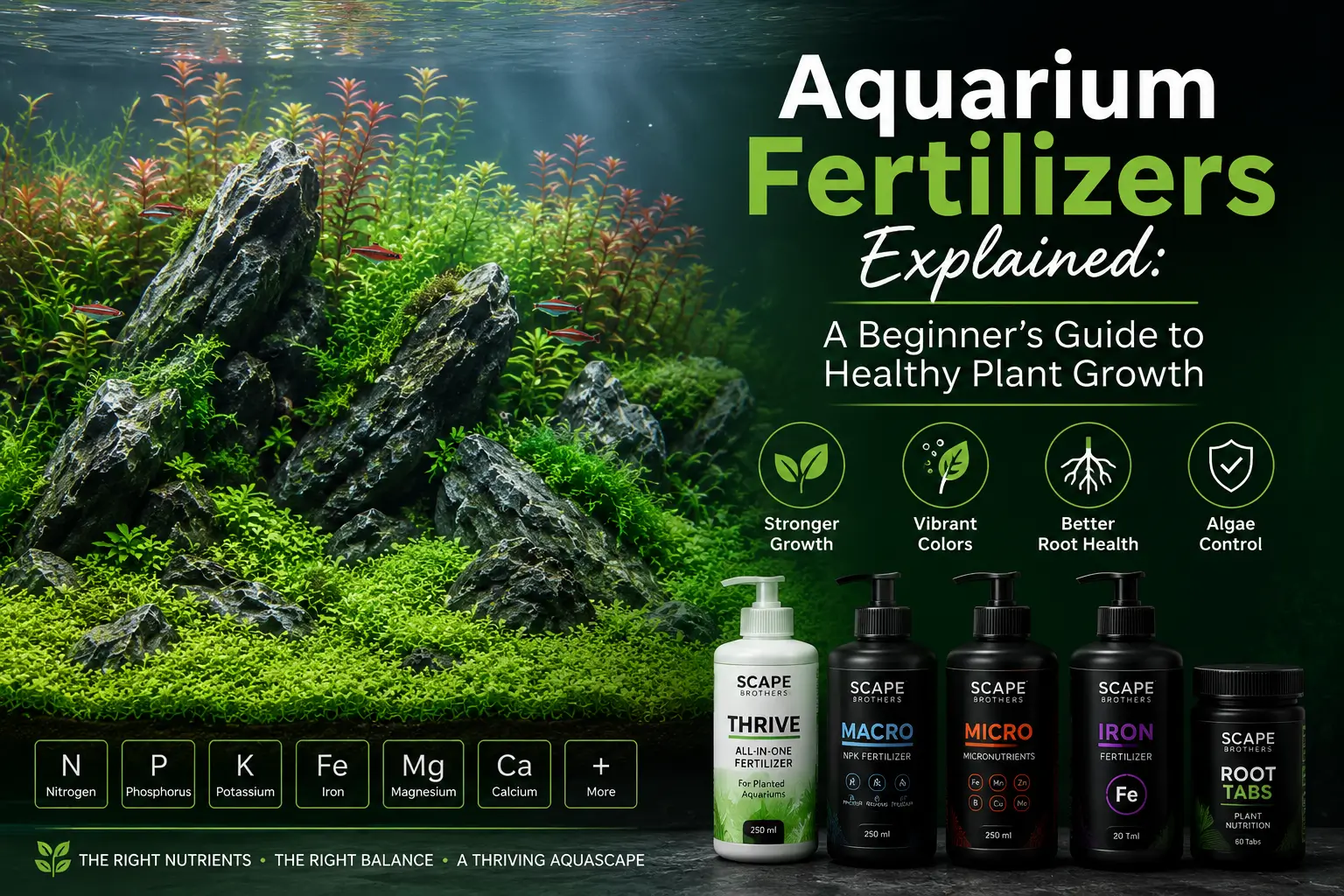
Aquarium Fertilizers Explained: A Beginner’s Guide to Healthy Plant Growth
A planted aquarium can look beautiful when it is first set up, but keeping aquatic plants healthy and growing well requires more than just good lighting and water.
Plants need nutrients.
This is where aquarium fertilizers come in.
If you’ve ever looked at an aquarium fertilizer bottle and wondered what NPK, iron, potassium, micronutrients or trace elements actually mean, you’re not alone.
The good news is that understanding planted aquarium fertilizers is much easier than it first appears.
In this guide, we’ll explain what aquarium plants need, when fertilizers are necessary, how different nutrients work and how beginners can avoid one of the most common mistakes—adding too much fertilizer too quickly.
Why Do Aquarium Plants Need Fertilizer?
Aquatic plants require nutrients for photosynthesis, new leaves, root development and overall growth.
Some nutrients are naturally available in aquarium water, while others may come from the substrate, fish waste, tap water or decomposing organic matter.
However, these sources aren’t always enough—especially in heavily planted aquariums.
A well-balanced planted aquarium provides plants with:
- Light
- Carbon
- Macronutrients
- Micronutrients
- Water
- Suitable growing conditions
If one of these becomes significantly limited, plant growth can suffer.
The Three Main Macronutrients: NPK
The most commonly discussed macronutrients are:
Nitrogen (N)
Phosphorus (P)
Potassium (K)
These are required by plants in relatively large quantities.
Nitrogen
Nitrogen is important for plant growth and the production of proteins and chlorophyll.
In aquariums, nitrogen can come from:
- Fish waste
- Uneaten food
- Decomposing organic matter
- Aquarium fertilizers
A heavily stocked aquarium may already provide a significant amount of nitrogen.
A lightly stocked or heavily planted aquarium may require additional supplementation.
Phosphorus
Phosphorus plays an important role in energy transfer and plant growth.
Despite common fears about phosphate, phosphorus itself isn’t automatically the cause of algae.
An aquarium is an ecosystem, and algae problems are usually related to an imbalance between available nutrients, light, carbon and overall aquarium conditions.
Potassium
Potassium is an essential plant nutrient involved in many biological processes.
Unlike nitrogen and phosphorus, potassium isn’t generally produced in significant quantities by fish waste.
For this reason, potassium supplementation can be particularly useful in planted aquariums.
What Are Micronutrients?
Plants need other nutrients in much smaller quantities.
These are called micronutrients or trace elements.
They include elements such as:
- Iron
- Manganese
- Zinc
- Copper
- Boron
- Molybdenum
Even though plants require these nutrients in smaller amounts, they are still essential.
Iron, for example, plays an important role in chlorophyll production and healthy new growth.
Do All Aquariums Need Fertilizer?
No.
The amount of fertilizer required depends on the aquarium.
Consider:
- Number of plants
- Plant species
- Lighting intensity
- CO₂ availability
- Fish stocking
- Substrate
- Water source
- Plant growth rate
- Frequency of water changes
A low-light aquarium containing slow-growing Anubias and Cryptocoryne may require very different fertilization from a high-light, CO₂-injected aquarium filled with fast-growing stem plants.
There is no single fertilizer schedule that is perfect for every aquarium.
Liquid Fertilizer vs Root Fertilizers
Not all plants take up nutrients in exactly the same way.
Liquid Fertilizers
Liquid fertilizers add nutrients to the water column.
They can be particularly useful for plants that feed heavily through their leaves, including many:
- Stem plants
- Mosses
- Anubias
- Java Ferns
Root Fertilizers
Root tabs and other substrate fertilizers are placed near the roots.
They can be especially useful for plants that obtain a significant amount of nutrition through their root systems.
Examples include many:
- Cryptocoryne
- Echinodorus
- Other rooted plants
In some aquariums, using both approaches can make sense.
How Do You Know If Your Plants Need More Nutrients?
Don’t rely on a single symptom.
Look at the aquarium as a whole.
Possible signs of nutrient deficiencies can include:
- Slow growth
- Pale or yellowing leaves
- Small new leaves
- Poor development
- Transparent or damaged older leaves
- Weak stems
- Poor coloration
However, similar symptoms can also be caused by:
- Incorrect lighting
- CO₂ limitations
- Poor water circulation
- Plant adaptation
- Root damage
- Incorrect planting
- Algae covering the leaves
This is why simply adding more fertilizer isn’t always the solution.
How Much Fertilizer Should You Add?
Always follow the recommended dosage of the fertilizer you are using.
For a new aquarium, it’s generally better to observe and adjust gradually rather than immediately increasing the dose because you want faster growth.
Keep track of:
- Plant growth
- New leaves
- Algae
- Water parameters
- Water changes
If plants are growing well and algae is under control, there may be no reason to dramatically change your routine.
Fertilizer and Algae: The Common Misunderstanding
One of the biggest myths in planted aquariums is:
“Fertilizer causes algae.”
The reality is more complicated.
Algae is a natural part of aquatic ecosystems.
Excess nutrients can contribute to problems, but algae growth is influenced by the overall balance of:
Light + CO₂ + nutrients + plant growth + maintenance + organic waste
Removing fertilizer completely isn’t necessarily the answer.
In fact, nutrient-starved plants can become weak and struggle to compete with algae.
The goal is not to eliminate nutrients.
The goal is to provide balanced conditions that favour healthy plant growth.
A Simple Fertilizer Routine for Beginners
If you’re new to planted aquariums, keep things simple.
- Start with the recommended fertilizer dosage.
- Maintain a consistent lighting schedule.
- Keep CO₂ consistent if you use it.
- Perform regular water changes.
- Observe new plant growth.
- Watch for algae.
- Make changes gradually.
Consistency is usually more useful than constantly changing your routine.
Scape Brothers® Fertilizers
At Scape Brothers®, our fertilizers are designed with planted aquariums in mind.
Our range includes Macro and Micro nutrient formulations, providing the nutrients required to support healthy aquatic plant growth.
Use fertilizers as part of a complete aquarium routine rather than treating them as a solution for every plant problem.
A good fertilizer works best when combined with appropriate lighting, CO₂, substrate, water quality and regular maintenance.
Final Thoughts
Fertilizing a planted aquarium doesn’t need to be complicated.
Understand the basics, start conservatively and learn to observe your plants.
The most important thing isn’t finding the “perfect” fertilizer schedule.
It’s learning how your particular aquarium responds.
As your experience grows, you’ll become better at identifying whether a plant needs more nutrients, better lighting, improved CO₂ or simply more time to establish.
Healthy plants come from balance—not from adding more of everything.
Ready to Feed Your Plants?
Explore the Scape Brothers® planted aquarium fertilizers and choose the right nutrients for your aquascape.
Grow better. Observe more. Aquascape smarter.