
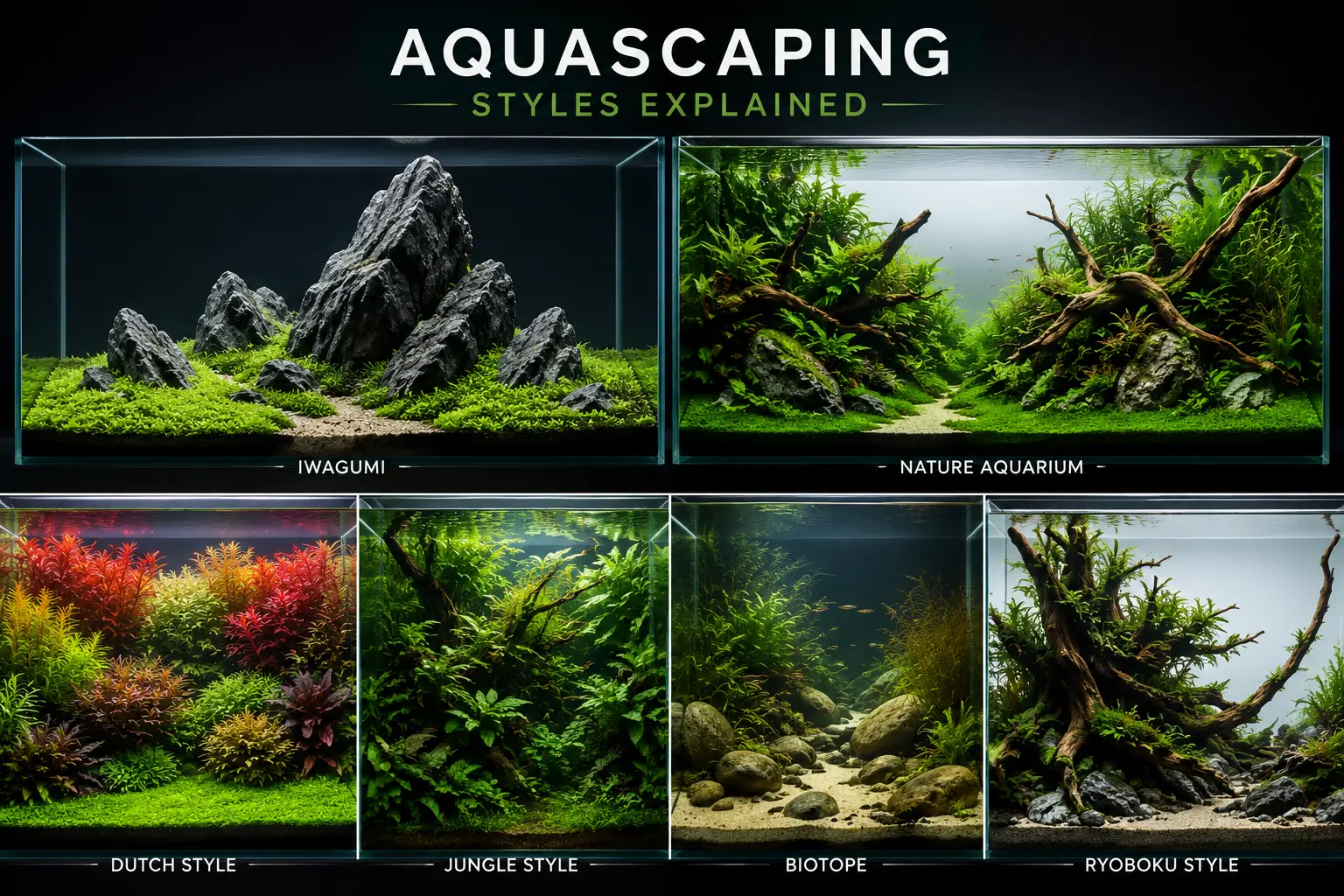
Aquascaping Styles Explained: Iwagumi, Nature Aquarium, Dutch & More
One of the most exciting things about aquascaping is that there isn’t just one way to create a planted aquarium.
Some aquascapes are minimalist and dominated by rocks.
Others are filled with colourful plants.
Some resemble underwater forests, while others are carefully designed to look like mountains, valleys or rivers.
These different approaches are known as aquascaping styles.
Understanding the major styles can help you decide what kind of aquarium you want to create.
Nature Aquarium
The Nature Aquarium style aims to recreate the feeling of a natural landscape underwater.
It often combines:
- Rocks
- Driftwood
- Aquatic plants
- Open space
- Depth
- Natural-looking compositions
The goal isn’t necessarily to copy a specific location.
Instead, the aquascape creates the impression of a natural scene.
Nature Aquarium layouts are one of the most popular choices for aquascapers because they offer enormous creative freedom.
Iwagumi
Iwagumi is a minimalist style centred around rocks.
The word is associated with Japanese rock arrangements.
A typical Iwagumi layout uses several stones arranged according to a deliberate composition.
The largest stone acts as the main focal point, while smaller stones support it.
Iwagumi aquascapes often feature:
- Stone-dominated hardscape
- Minimal plant variety
- Open space
- Carpet plants
- Strong composition
Although Iwagumi may look simple, creating a convincing one can be surprisingly challenging.
Every stone becomes important because there are fewer elements to hide mistakes.
Dutch Style
Dutch aquariums are very different from minimalist Iwagumi layouts.
The focus is primarily on plants.
Different species are carefully arranged according to:
- Colour
- Leaf shape
- Height
- Texture
- Growth pattern
Rather than relying heavily on rocks and driftwood, the plants themselves create the landscape.
A successful Dutch-style aquarium can look like an underwater botanical garden.
Regular trimming and maintenance are extremely important.
Jungle Style
Jungle-style aquariums are lush, dense and natural-looking.
Unlike highly structured Dutch aquariums, jungle layouts often allow plants to grow more freely.
The result can resemble an underwater forest.
Jungle-style aquariums are particularly attractive to aquarists who enjoy dense planting and a less formal appearance.
However, “natural” doesn’t mean “no maintenance.”
Regular trimming is still necessary to prevent plants from completely overwhelming the aquarium.
Biotope Aquariums
A biotope aquarium attempts to recreate a particular natural environment.
Instead of simply choosing plants and fish because they look good together, the aquarist researches a specific ecosystem.
This might be:
- A particular river
- Lake
- Stream
- Region
- Geographic habitat
The plants, fish, substrate and hardscape are selected to reflect that environment as accurately as possible.
Biotope aquariums are particularly interesting for aquarists who enjoy researching natural habitats.
Ryoboku Style
Ryoboku-style aquascapes are strongly associated with driftwood.
The wood forms the primary structural element and is often arranged to resemble:
- Trees
- Forests
- Roots
- Branches
- Fallen timber
Plants are then used to complete the scene.
With the right wood and planting, a Ryoboku layout can create an incredible sense of depth.
Which Aquascaping Style Is Best for Beginners?
There isn’t one correct answer.
The best style is the one that matches:
- Your aquarium
- Your equipment
- Your plants
- Your maintenance routine
- Your experience
- Your personal taste
If you love rocks and minimalism, try Iwagumi.
If you enjoy plants, consider Dutch or Jungle style.
If you want rocks, wood and plants together, Nature Aquarium may be ideal.
The important thing is to start with a design you genuinely enjoy.
Can You Mix Aquascaping Styles?
Absolutely.
Aquascaping isn’t a strict rulebook.
You can take ideas from different styles and create your own interpretation.
For example, you could combine:
- Iwagumi-inspired rocks
- Nature Aquarium planting
- Driftwood elements
- Jungle-style plant growth
The result doesn’t need to fit perfectly into one category.
Your aquarium is your creative space.
How to Choose a Style for Your Aquarium
Before buying equipment and plants, ask yourself:
Do I want lots of plants?
If yes, Dutch or Jungle styles may suit you.
Do I prefer rocks?
Consider Iwagumi or a rock-focused Nature Aquarium.
Do I love driftwood?
Explore Ryoboku or Nature Aquarium layouts.
Do I want something highly natural?
Nature Aquarium or Biotope may be suitable.
Do I want low plant variety?
A minimalist Iwagumi layout may be a better choice.
The Most Important Rule of Aquascaping
Don’t become too focused on labels.
Aquascaping styles are useful because they give you inspiration and a design framework.
But they shouldn’t prevent creativity.
You don’t need to recreate someone else’s aquarium exactly.
Study different layouts.
Understand why they work.
Then create something of your own.
Final Thoughts
Aquascaping combines nature, design and creativity.
From the simplicity of Iwagumi to the dense planting of Dutch-style aquariums, every style offers something different.
Experiment with different ideas and don’t be afraid to develop your own style.
Over time, you’ll discover which plants, hardscape materials and compositions you enjoy working with most.
And that’s one of the best parts of aquascaping:
There is always another landscape to create.
Explore Scape Brothers® for aquascaping hardscape, plants, fertilizers, tools and aquarium accessories to help bring your next underwater landscape to life.
Plan. Build. Grow.